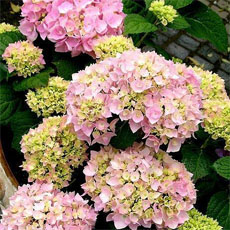
According to Hydrangeas: A Gardener's guide revised, by Toni Lawson-Hall and Brian Rothers, this plant was found wild in Ohio by EH Hill,...Read More AM date is 1907. The plant needs space and time to grow large. It increases by suckering to a large bush. It is criticized because its large flower heads tend to flop on their slender stems. On a large, well-developed shrub, the central flowers are held erect, while the outer ones dip more than they actually flop. Despite its name, the flower heads are not as large as 'Annabelle' but they are numerous and irregular in shape. The individual flowers are large for this species. Sepals are more pointed than those of 'Anabelle.' White blooms from July to early autumn. It is a hardy plant that withstands late frosts, and is resistant to periods of drought. Flower shape: flat/convex, irregular, lax; Head size: small/medium; Sterile flowers: flat, crowded, overlapping; Sepal number: 3-5, mainly 4; Sepal immature: lime green; Sepal mature: white/palest cream; Sepal autumnal: bading brown; Fertile flower immature: green; fertile flower mature: cream; Peduncle very pale green, Pedicel: cream; reported for pH of 6.5. Leaf color is yellowish green, matt texture, lack of leaf is lighter, veins are central, raised on back, branch is grey or green, petiole is red above, green bleow. Hieght: large, flowering time: early to late.
I have grown this on an exposed hill where it gets very poor moisture, and only dies in the intense heat of August when I give up watering. It overtook the PG hydrangea that couldn't survive a lawn mower. This outlaw just keeps suckering new shoots and it comes back stronger than ever in spite of its poor treatment.
In "Hydrangeas for American Gardens," by Michael A. Dirr (2004), it says that 'Grandiflora' is often referred to as the Hills of Snow Hyd...Read Morerangea. The corymbs are 6" to 8" across with primarily sterile white flowers; the individual "sterile" showy sepals are larger that that of 'Annabelle', but the total number of flowers in a head is fewer; the heads are not so radially symmetrical, looking like four parts loosely pushed together, and soon becoming floppy in appearance.
This cultivar, discovered growing wild in Ohio in the late 1800s, was planted througout the Midwest, East, and upper South. Plants sucker and form large colonies, 10 to 20' across.
Not as widely available as 'Annabelle', but is still reliable and a showy shrub.
The flowers on this cultivar are so heavy that they resemble summer-blooming peonies from a distance. This shrub can grow very large, so...Read More may require pruning to keep it within bounds unless sufficient space can be provided.
According to Hydrangeas: A Gardener's guide revised, by Toni Lawson-Hall and Brian Rothers, this plant was found wild in Ohio by EH Hill,...Read More
In "Hydrangeas for American Gardens," by Michael A. Dirr (2004), it says that 'Grandiflora' is often referred to as the Hills of Snow Hyd...Read More
The flowers on this cultivar are so heavy that they resemble summer-blooming peonies from a distance. This shrub can grow very large, so...Read More